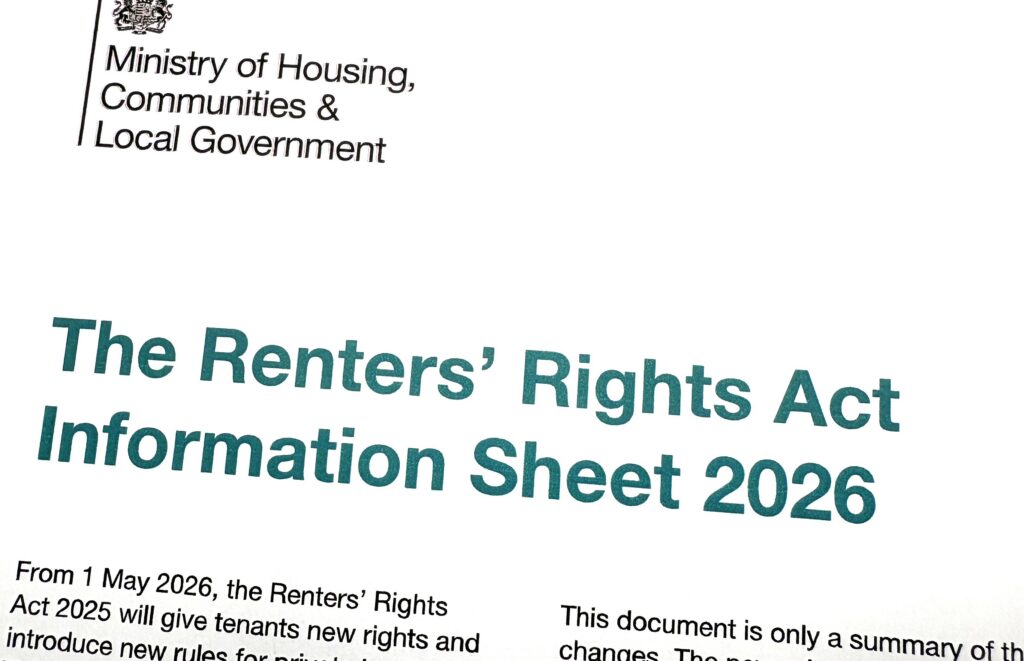
The Renters' Rights Act is now in force and there's now just a few days remaining to send the Government Information Sheet to all existing tenants.
If letting agents manage the property, they have a legal obligation to send the Information Sheet to tenants, even if the landlord has already served it.
Each 'adult named tenant' who was in a tenancy on 1st May 2026 must receive the official Government information sheet before 31st May 2026. Failure to provide it could result in fines of up to £7,000.
A few important reminders:
- It must be sent to every named tenant individually
- The official Government PDF must be used
- If sending by email, the PDF must be attached (not linked)
- Keep evidence that it was sent
If you haven't completed this yet, don't leave it until the last minute.
Section 21 notices surge before abolition
Hundreds of tenants across England received no-fault eviction notices in the final days and hours before section 21 evictions were banned under the Renters’ Rights Act on 1st May, according to reports from tenants and legal professionals.
Solicitors reported increased requests to serve last-minute eviction notices before the deadline, with some requiring hand delivery when postal services could not meet the timeframe. The rush to issue notices has left affected tenants facing uncertainty and potential homelessness.
All possession claims must now be brought under revised Section 8 grounds, requiring clear justification and evidence.
New thresholds for rent arrears and possession
Under the new framework, rent arrears possession cases are now subject to revised thresholds:
- A minimum of three months’ arrears is required for mandatory possession under Ground 8
- A four-week notice period applies across arrears-related grounds
- Courts will retain discretion in lower-level arrears cases, where possession is not automatic
- This introduces a more complex enforcement landscape, requiring careful assessment of the strength of each case before action is taken.
Stronger focus on evidence and compliance
With possession now entirely reliant on statutory grounds, the importance of accurate record-keeping and evidential support has increased significantly.
For many agents, this is a complete operational reset. Processes established under the Housing Act 1988 that relied on flexibility will now need to be torn out at the root. Precision in all things will be the absolute minimum.
Agents and landlords will need to demonstrate clear compliance with rent arrears processes, tenancy documentation, and communication trails in order to avoid delays or dismissed claims.
What is changing: From Section 21 to Section 8
For years, Section 21 notices were the go-to for many landlords and letting agents looking to end assured shorthold tenancies. Before the Renters' Rights Act, these notices were quick, relatively simple to file, and didn't require naming a specific reason to start the possession process.
Under the Renters' Rights Act, this option is no longer available.
With Section 8 notices becoming the only way to regain possession, the weight of compliance is much heavier. Initiating possession proceedings now requires proceeding with a clear strategy from the onset of the tenancy. With periodic tenancies offering tenants much more flexibility, landlords and letting agents won't be able to "let and forget".
Here are three things you'll have to remember going forward:
1. Every eviction must be justified
Agents and landlords will need to use the correct grounds and ensure their notice fully meets the legal criteria. Using the wrong ground could lead to delays or even a complete dismissal.
2. Evidence is king
Eviction notices will need to be backed by robust, well-documented evidence to support possession claims. This could include rent schedules, inspection reports, the terms of the tenancy agreement, any written communications, and anything relevant to the claim (such as third-party complaints relating to anti-social behaviour). The better the records, the better chance a properly filed notice will have.
3. Timelines may become less predictable
Without the ease of Section 21 notices, legal cases against tenants may take longer to prepare and process. This is especially true with discretionary grounds, where the criteria is harder to prove than mandatory grounds. Poorly prepared applications are much more likely to fail.
What's the difference between mandatory and discretionary grounds?
In a post-RRA world, agents need to understand how Section 8 grounds are structured and how they operate in practice. Each ground reflects a particular situation, from rent arrears to changing landlord circumstances, and each comes with its own legal requirements, notice periods, and evidence.
The most basic part of Section 8 notices is that the grounds fall into two distinct categories:
Mandatory grounds
If a tenant is evicted on a mandatory ground, this means a court must grant possession if the landlord or managing agent can prove the ground applies and all the requirements are met.
These grounds are typically used in more clear-cut cases, such as serious rent arrears or a landlord wishing to sell or move into the property.
Discretionary grounds
In cases involving discretionary grounds, the court will have the final decision on whether it is reasonable to grant possession. This means that there is an additional level of judgement in play, where the court will take factors like the behaviour and circumstances of the tenant into account.
In practice, many possession claims rely on a combination of grounds. For example, an agent dealing with persistent late rent payments may cite both rent arrears-based and conduct-based grounds to strengthen the case.
Another key consideration is notice periods. Each ground for eviction has its own minimum notice requirement, and these can vary significantly depending on the reason for possession. Serving the correct notice at the correct time is critical, as errors here can invalidate the eviction claims and any subsequent court proceedings.
To see a full list of legally defined grounds, click here.
Tenants remain ignorant about Renters Rights Act
While it’s been headline news since 1 May, it appears that one in three tenants still don’t know anything about how the Renters’ Rights Act impacts them.
A survey of just over 1,000 tenants shows ell over a third having little to no knowledge about the Renters Rights Act.
On top of that, 88% have made no efforts to speak to their landlord or letting agent about how the Act might impact their tenancy and their rights.
Just a quarter of tenants (25%) surveyed describe themselves as “very familiar” with the Act, while more than a third (36%) say they are either aware of it by name alone, or not at all.
Some 88% have not sought information from other sources, such as solicitors, online resources, or tenant advocacy organisations.
Among the minority who have taken steps to better understand the legislation, specific questions are already beginning to emerge.
The most commonly raised issue relates to changes to tenancy structures, including the abolition of Assured Shorthold Tenancies, cited by 26% of respondents.
This is followed by questions around revised rent increase rules (21%) and strengthened legal obligations for property standards, including issues such as damp and mould (21%).
Additionally, 18% of those seeking advice say they have done so to better understand how the Act will impact pet ownership rights.
Some 60% of tenants say they feel confident in their understanding of how the Act will affect their tenancy. However, this means 40% still appear to be less aware or unaware.
While 44% of tenants report having no concerns about the changes, those who do express particular worries or confusion around rent increases (23%), as well as the possibility of shifts in landlord behaviour.
Around 17% expressed concern that the new regulatory landscape could lead to more frequent, intrusive, or stringent property inspections and increased oversight during their tenancy.
Potential concerns lie in whether or not landlords will now look to force evictions based on the most minor of infractions.
A spokesperson for Propoly, which commissioned the research, said “if tenants aren’t aware of their rights, they are far less likely to raise issues with their letting agents or landlords, or to challenge situations where those rights may not be upheld.”