
UK build to rent has made huge progress over the past decade, becoming less of a ‘niche’ area and more a mainstream development strategy to plug the rental supply gap.
Rising rental demand has sparked much of this growth, along with changing trends among today’s tenants who increasingly want better standards of accommodation with a view to long-term community building, with additional amenities and services that tenants are willing to pay for.
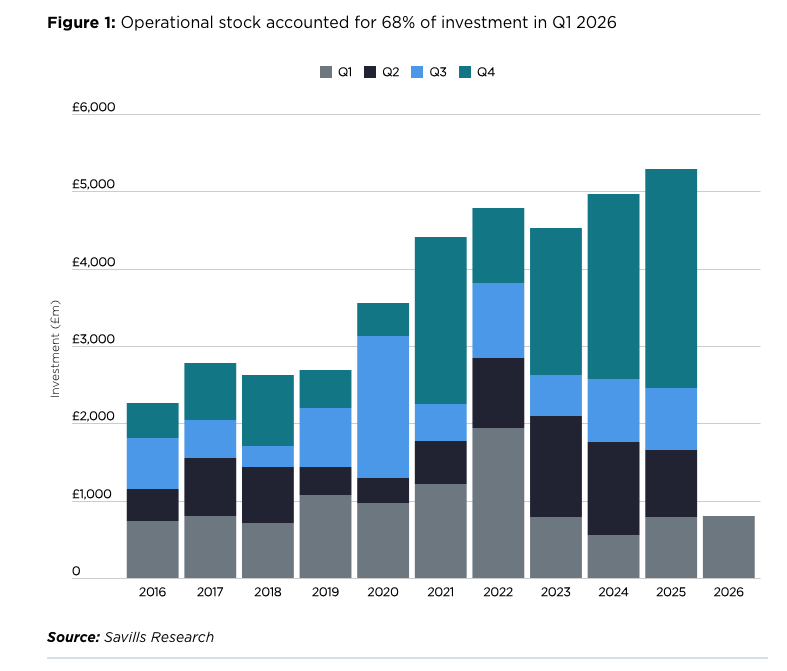
New research from Savills shows a strong start to the year with UK build-to-rent (BTR) investment in Q1 2026 reaching £795 million, dominated by acquisitions of operational assets.
The £795 million figure is the highest first quarter of investment in the sector since 2022.
Laura Skoda, director, London residential investment at Savills Operational Capital Markets, said “activity has been driven primarily by investors acquiring operational stock, which has accounted for 68% of investment. Over three-fifths of that were in London. With significant capital still targeting well-located, income-producing assets, we expect deal flow to remain strong as the year progresses.”
Beyond London, Pension Insurance Corporation purchased Ebb & Flow in Reading from Lincoln MGT, which was the largest acquisition of an operational asset outside of central London on record.
Following a bumper end to 2025, single family rental (SFR) investment volumes had a slower start to 2026. However, with several large transactions currently progressing through legals, Savills expects to see strong Q2 numbers.
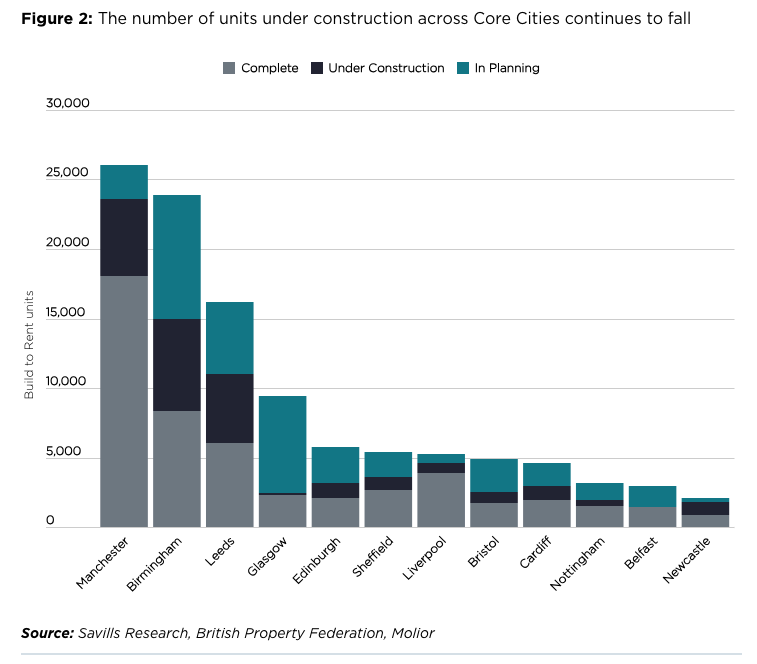
Richard Valentine-Selsey, head of European living research at Savills, said “across the UK’s 12 core cities, the total number of BTR units in the pipeline rose to c.108,000 at the end of Q1 2026. This was up 3% compared with a year earlier. However, the challenges facing urban high-rise development have continued to weigh on construction activity. The number of units under construction across the core cities fell by 11% between Q1 2025 and Q1 2026, due to completions outstripping new starts. This trend is likely to continue, with urban multifamily funding transactions remaining muted, as deals take longer to progress given headwinds from planning, building safety and construction cost inflation.”
Highlights:
- New research from Savills shows a strong start to the year with UK build-to-rent (BTR) investment in Q1 2026 dominated by acquisitions of operational assets
- The £795 million transacted in Q1 is the highest first quarter of investment in the sector since 2022
- Following a bumper end to 2025, single family rental (SFR) investment volumes had a slower start to 2026 but several large transactions are currently in progress
- The number of units under construction across the core cities fell by 11% between Q1 2025 and Q1 2026
National Housing Bank Makes Significant Investment into Build to Rent Fund
The National Housing Bank (NHB) has joined as a cornerstone investor in Starlight UK’s Build-to-Rent (BTR) Fund II, supporting the acceleration of BTR delivery across England.
It's great to see the National Housing Bank (NHB) get off to a flying start in the BTR sector with a cornerstone investment commitment of £100 million to Starlight UK’s Build to Rent (BTR) Fund II.
The fund will develop professionally managed rental housing in structurally undersupplied markets, including major regional cities such as Manchester, Liverpool and Leeds, as well as key London commuter belt locations. The homes will be located close to employment, education and transport supporting wider economic growth and regeneration in local communities.
Over the next decade, the National Housing Bank aims to invest up to £16 billion through debt, equity, and guarantee products, “stepping in where the market cannot”.
Almost simultaneously, north of the border, the Scottish National Investment Bank invested £50 million into L&G’s Build to Rent (BTR) Fund, supporting the delivery of high-quality, purpose built privately rented homes across Scotland.
It's a clear vote of confidence in the BTR sector from the governments of England and Scotland and a sign they are prepared to put their money where their mouths are. Both of these initial commitments are to established institutional players who are developing and acquiring assets on a large scale. This type of activity is essential, but I'd also like to see the NHB acting as a sympathetic lender to enable SME developers to deliver projects in regional towns and cities. It would be a shame if all the proposed £16 billion NHB cash goes to the big boys.
NRLA to work with Build To Rent funds
The National Residential Landlords Association (NRLA) has recently launched NRLA Living, aiming to expand its activities amongst Build to Rent (BTR) operators, large scale portfolio landlords, investors, funders and associated professional services companies.
A statement from the body said “this new offering provides high-quality market insights to help subscribers plan and manage their portfolios more effectively. Its cutting edge analysis means users can draw from clear, informed practical guidance on how they can equip themselves to maximise operational efficiency.”
It says that with regulatory pressures making it tougher than ever to be a landlord let alone running complex, large scale portfolios, NRLA Living will “ensure subscribers have the tools to manage risk and make better informed investment decisions over the long term.”
NRLA Living’s services are designed explicitly for those landlords, investors, operators and businesses who oversee large, complex, scaling portfolios looking for ways to stay compliant with current regulations or optimise their operations. It also adds that by benefitting from the NRLA’s wide ranging rented sector expertise subscribers can also feel confident that they are receiving support from an organisation that is at the forefront of shaping UK regulations and promoting responsible landlords of all shapes and sizes.
NRLA chief executive Ben Beadle said “the Private Rental Sector is undergoing once in a generation reforms, and the acute shortage of rented homes is creating significant issues for tenants. Traditional private landlords are pivotal to the future of the PRS and central to the NRLA’s mission, but we recognise the need for a diversity of offer if we are to meet demand.
The launch of NRLA Living to support portfolio landlords and institutional investors with NRLA’s sector leading advice, compliance support, market intelligence and a voice that champions responsible landlords of all kinds, comes at a critical moment for the PRS and at a time when government most needs landlords to have confidence, to help them solve the housing challenges now and in the future.”
The new service is being run by the association in partnership with lettings agency and property consultancy Bidwells, whose head of operational living 'Iain Murray' stated “Institutional backed residential portfolios at scale are becoming increasingly important to the UK’s housing mix, but operators, investors and businesses are facing unprecedented regulatory and operational complexity. NRLA Living arrives at exactly the right moment, giving large scale landlords, Investors and Build to Rent operators the clarity, insight and practical support they need to run efficient, compliant and resilient portfolios.
At Bidwells, we see first hand how vital high quality data and informed guidance are to making confident long term investment decisions. Partnering with the NRLA on this new service means we can help accelerate the evolution of the UK’s operational living sector and support the organisations delivering the homes our communities urgently need.”
BTR Alliance - Code of Practice for Build to Rent
A Code of Practice has been launched for the Build To Rent (BTR) sector.
It’s described as marking an industry first and follows nearly four years of development. Its authors say It will continue to be developed and refined during 2026 through further consultation and testing, ahead of it formally coming into force.
Its purpose is to provide residents within Build to Rent communities with a clear, verifiable standard of accommodation, amenity provision and lifestyle experience significantly above the statutory minimum.
A statement from Build To Rent support organisation Real Estate:UK said “for operators, investors, regulators and key stakeholders, the Code will ensure that they each have confidence in the sector’s ability to deliver high standards, self-regulate and hold itself to account in an effective, transparent and self-improving manner. This is viewed as critical in seeking to differentiate BTR from the wider PRS in terms of its ability to be scrutinised and be measured to drive an improvement in standards.”
From an operational perspective, the Code establishes a voluntary framework that enables operators, owners, and residents to engage effectively and fairly, and sets a new benchmark for service, quality, sustainability, security, and good governance.
It has received an expression of support from sector-leading firms including Grainger, Greystar, Get Living, Quintain, Legal & General, Long Harbour, Colby River, Moda Living, Packaged Living, Placefirst, Thriving Investments, Apache Capital, Touchstone, Vertus, VervLife and Way of Life.
Central to the new Code is the Charter of Commitments which it will enshrine. Seven core commitments include:
- Fair and reasonable renting – providing transparent terms, limiting deposits, ensuring quick returns and supporting residents.
- High-quality, safe homes – delivering and maintaining properties above national standards, never directly passing on safety-related costs by default wherever appropriate.
- Sustainability and decarbonisation – committing to measurable goals, including net zero by 2050, improving efficiency, minimising resource use, upgrading and maintaining homes to EPC C or higher.
- Professional, accountable service – ensuring responsive repairs, respectful notice before entry, and dedicated, qualified teams supported by inclusive hiring and ongoing training.
- Community and wellbeing – fostering vibrant, inclusive neighbourhoods by engaging residents and locals, supporting social and economic opportunities, respecting heritage, and measuring social impact.
- Transparency and governance – upholding accountable practices, fair employment, responsible supply chains, and a culture of inclusion, wellbeing, and continuous improvement.
- Championing the Code – embedding these standards across our organisations and advocating for consistent, high quality practices across the rental sector and to support the transparent governance of this Code so that our commitment can be independently verified.
This verification process will be developed throughout 2026, following which the full, operational Code will be active and open for full operator sign-up. Until this point, the Code is not yet live and no formal signatory status applies.
From a regulatory perspective, the Code is intended to augment existing legislation already in place, which all BTR operators are expected to have processes in place in order to meet the requirements of.
A key part of the Code is that all signatories are mandated to ensure that all relevant personnel are aware of, and actively maintain, statutory compliance in accordance with their legal obligations.
The Code forms part of the BTR Alliance’s wider work on improving the consumer experience and perception of BtR as a housing tenure of first choice.